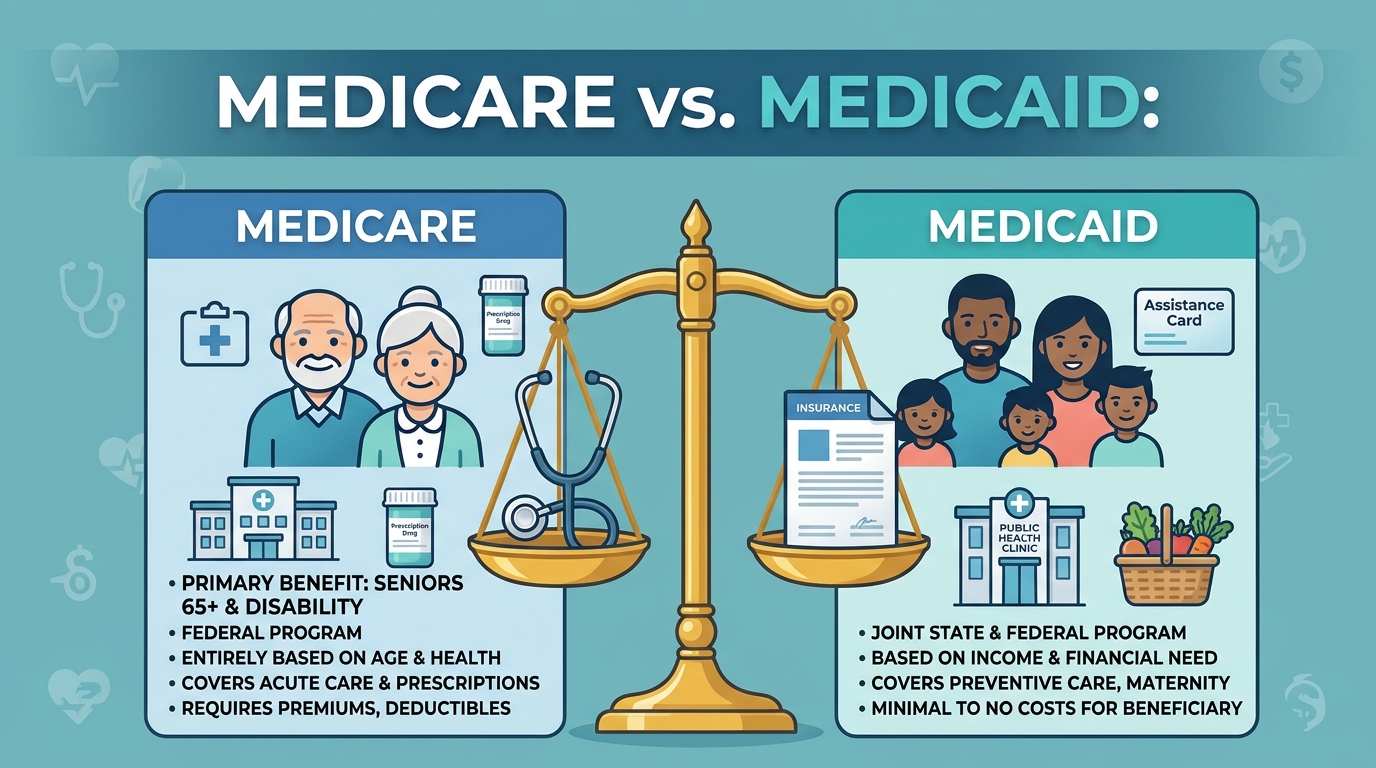
Medicare vs. Medicaid: Understanding Your Health Coverage Options
Navigating the American healthcare system can be challenging, especially when trying to distinguish between its two primary public insurance programs: Medicareand Medicaid. While their names sound remarkably similar, they are completely different programs with distinct eligibility requirements, funding structures, and coverage benefits.
Whether you are planning for retirement, caring for an aging parent, or exploring financial assistance options, understanding the differences between these two programs is crucial.
1. What is Medicare? (Insurance for Seniors and Individuals with Disabilities)
Medicare is a federal health insurance program managed by the Centers for Medicare & Medicaid Services (CMS). It is primarily designed for adults aged 65 and older, as well as younger individuals with specific disabilities or permanent kidney failure (End-Stage Renal Disease).
Because Medicare is an entitlement program funded through payroll taxes (FICA) that you pay during your working years, eligibility is based on age and work history, not on your income or financial wealth.
Medicare is divided into four main components:
- Part A (Hospital Insurance): Covers inpatient hospital stays, care in a skilled nursing facility, hospice care, and limited home health services. Most people do not pay a monthly premium for Part A if they or their spouse paid Medicare taxes for at least 10 years (40 quarters).
- Part B (Medical Insurance): Covers outpatient care, doctor visits, durable medical equipment (DME), and preventive services (like vaccines and annual wellness visits). Part B requires a monthly premium, which is determined by your income level.
- Part C (Medicare Advantage): An alternative all-in-one option managed by private insurance companies approved by Medicare. These plans bundle Part A and Part B, and usually include Part D along with extra benefits like dental, vision, and hearing care.
- Part D (Prescription Drug Coverage): Optional coverage that helps pay for brand-name and generic prescription drugs. It is run by private insurance companies approved by the federal government.

2. What is Medicaid? (Assistance for Low-Income Individuals and Families)
Medicaid is a joint federal and state program created to provide comprehensive health coverage to eligible low-income individuals and families. Unlike Medicare, Medicaid is strictly a needs-based program. To qualify, applicants must meet strict income and asset limits set by their government.
Key characteristics of Medicaid include:
- Comprehensive Care at Minimal Cost: Medicaid covers standard medical services such as doctor visits, hospitalizations, and preventive care. Because it targets individuals with limited financial means, out-of-pocket costs, deductibles, and co-pays are either non-existent or extremely low.
- Long-Term Care Coverage: Crucially, Medicaid is the primary government program that covers extended nursing home stays and long-term custodial care, which Medicare generally does not cover.
- State-by-State Variations: While the federal government provides broad guidelines and partial funding, each state administers its own Medicaid program. This means that eligibility thresholds, application processes, and even program names (such as Medi-Cal in California or TennCare in Tennessee) vary significantly depending on where you live.
3. Medicare vs. Medicaid: Key Differences At a Glance
| Feature | Medicare | Medicaid |
|---|---|---|
| Primary Target | Adults aged 65+ and individuals with qualifying disabilities | Low-income adults, families, children, and pregnant women |
| Administration | Federal program (consistent guidelines nationwide) | Joint federal-state program (rules vary by state) |
| Financial Limits | No income or asset limits | Strict income and asset limits apply |
| Out-of-Pocket Costs | Requires premiums, deductibles, and co-insurance | Little to no cost for the beneficiary |
| Long-Term Care | Limited to short-term rehabilitative care | Covers extended nursing home and long-term care |

4. Can You Have Both? (Dual Eligibility)
Yes, it is entirely possible to be enrolled in both programs simultaneously. Individuals who qualify for both are referred to as “dual eligibles.”
For dual eligibles, Medicare acts as the primary payer for medical services. Medicaid then acts as the secondary payer, stepping in to cover the out-of-pocket costs left behind by Medicare, such as monthly premiums, deductibles, and co-payments. This combination provides a vital financial safety net for low-income seniors and disabled individuals.